GROUND TRUTH LAYER
OpenFOAM CFD Data
The common physical source for every current U-sweep model test. The website keeps this layer separate so representation and dynamics methods can be compared without silently changing the CFD evidence underneath them.
ACCEPTED SOURCESeven U-sweep cases · canonical HDF5 available
CURRENT DATASET
One geometry, seven speeds, one controlled source contract
ORIGINAL CFD REFERENCE
Force histories and instantaneous flow field · case by case
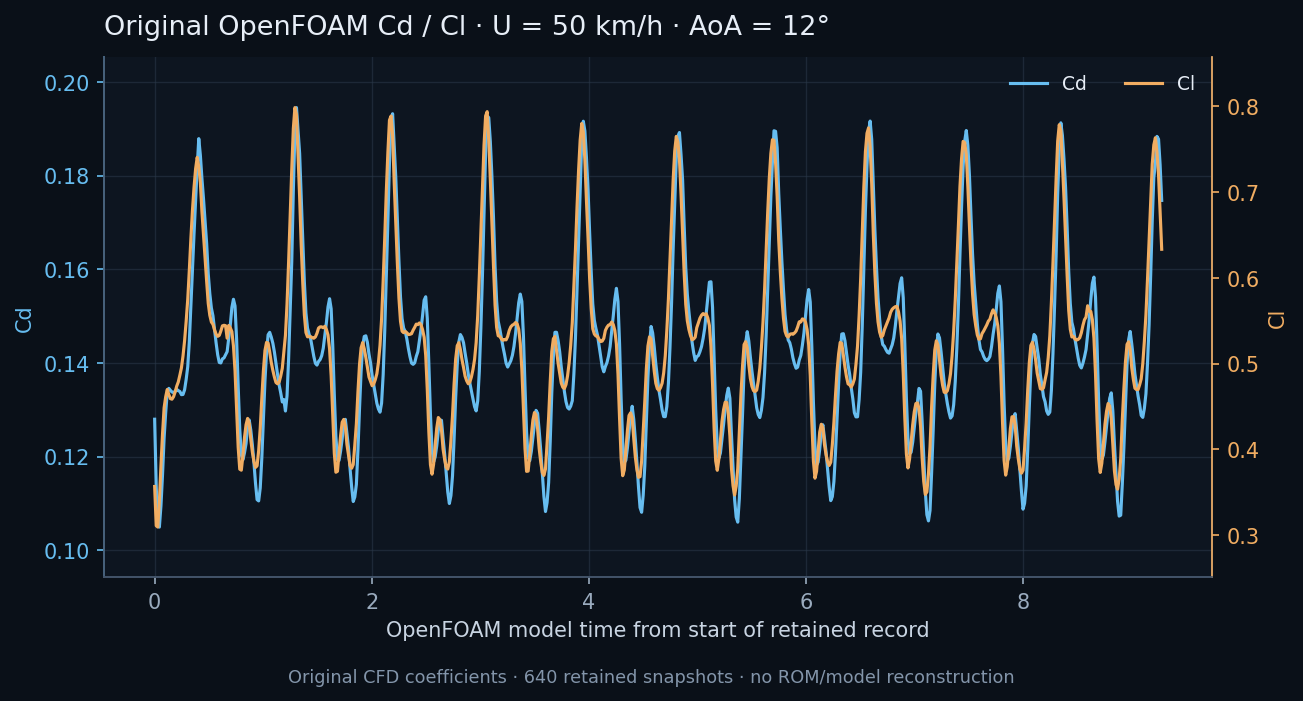
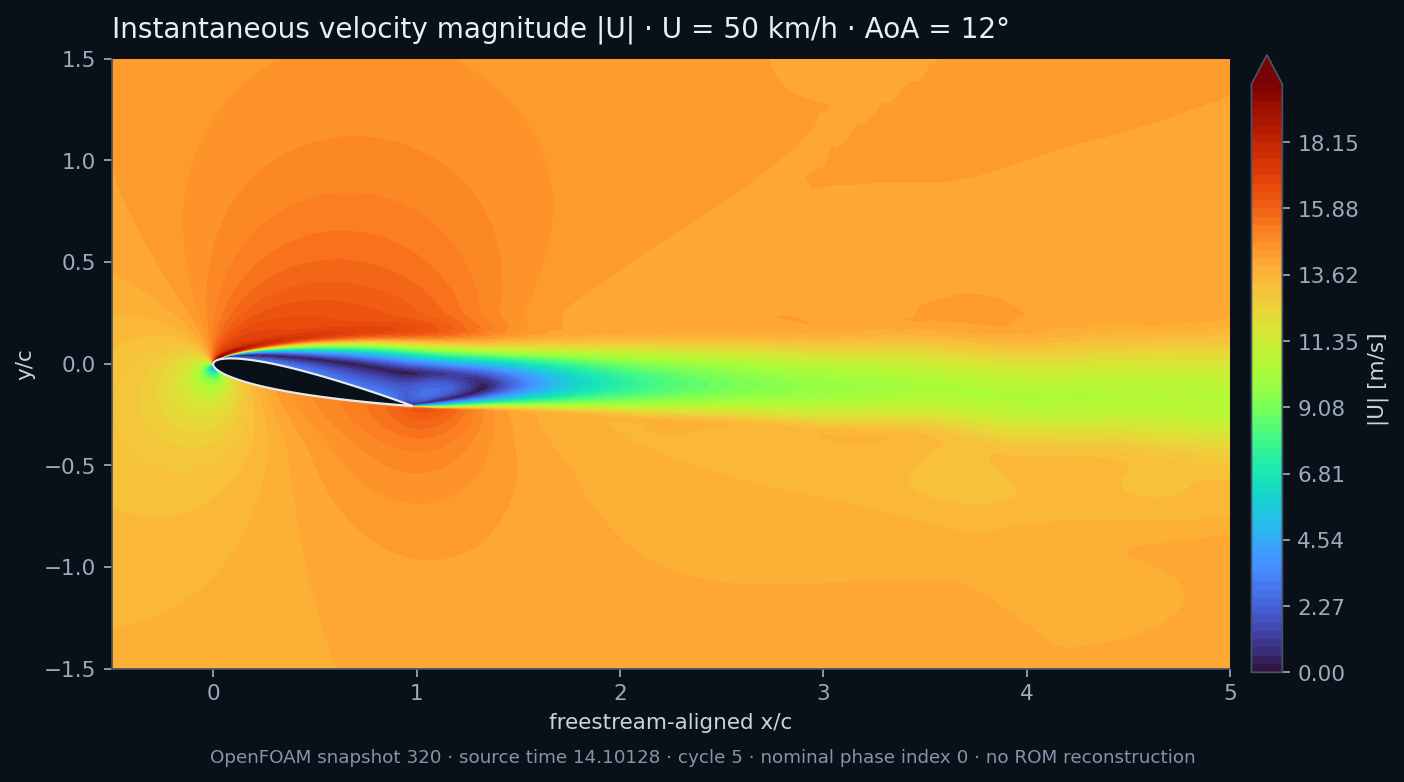
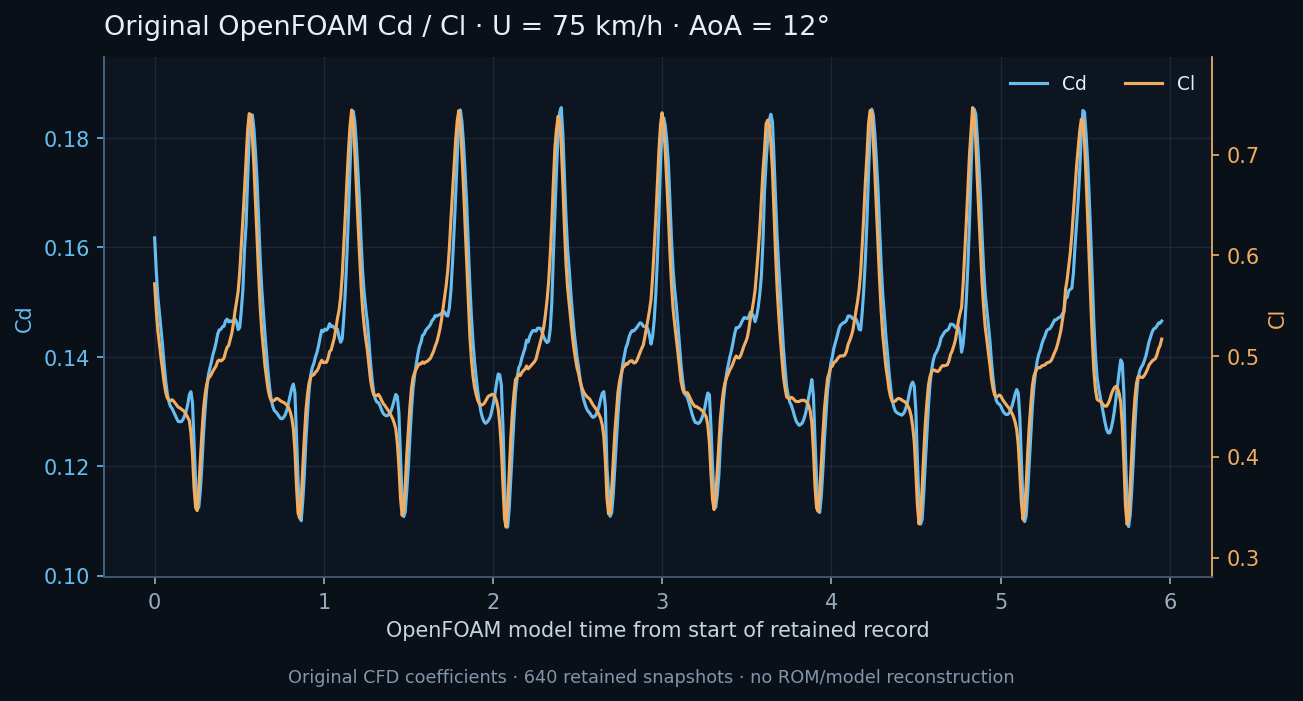
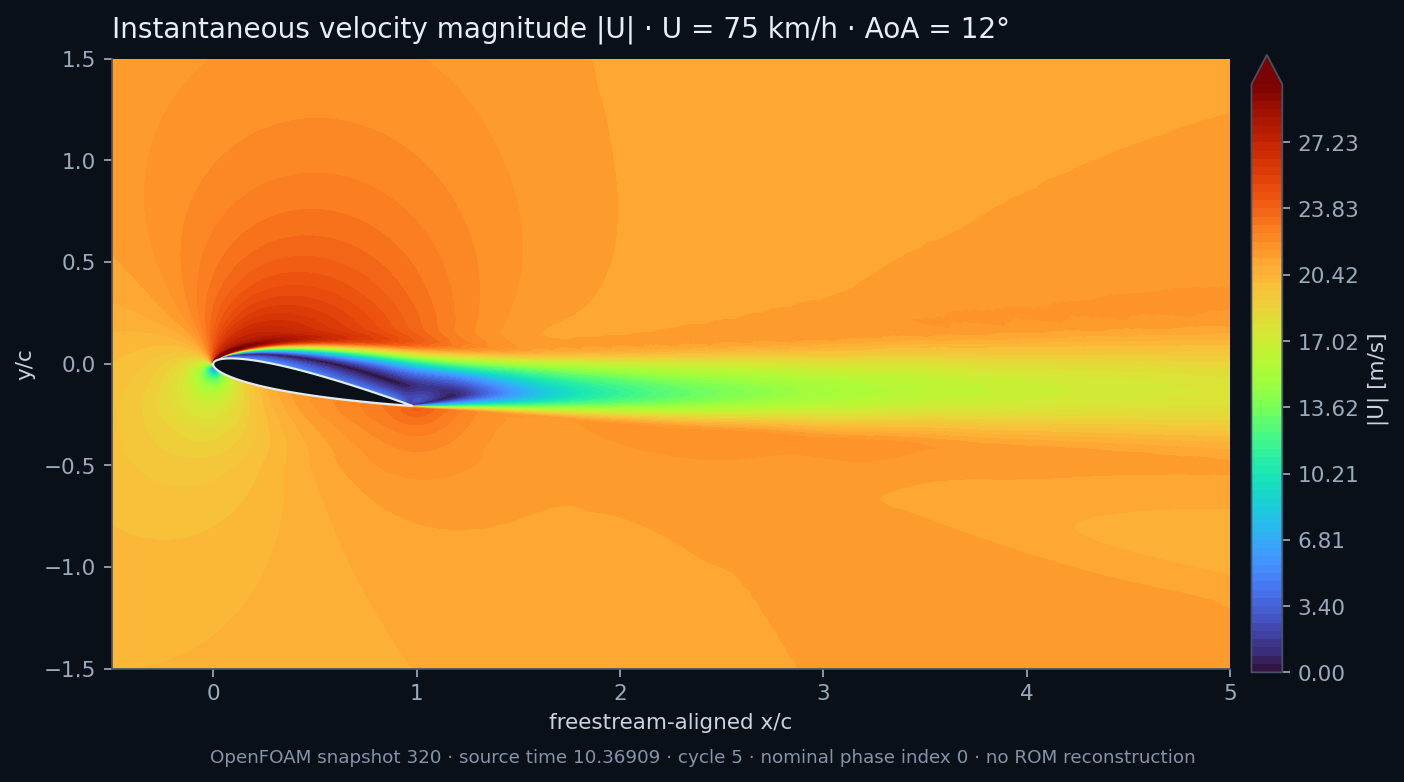
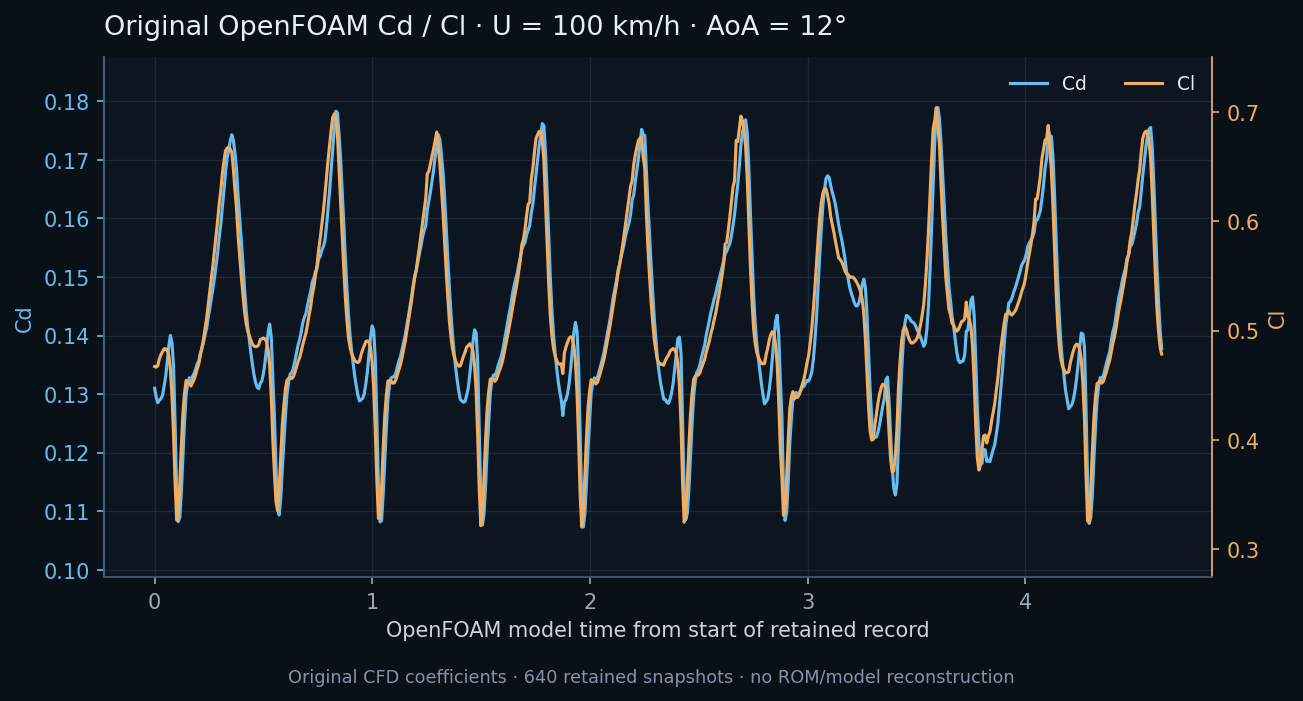
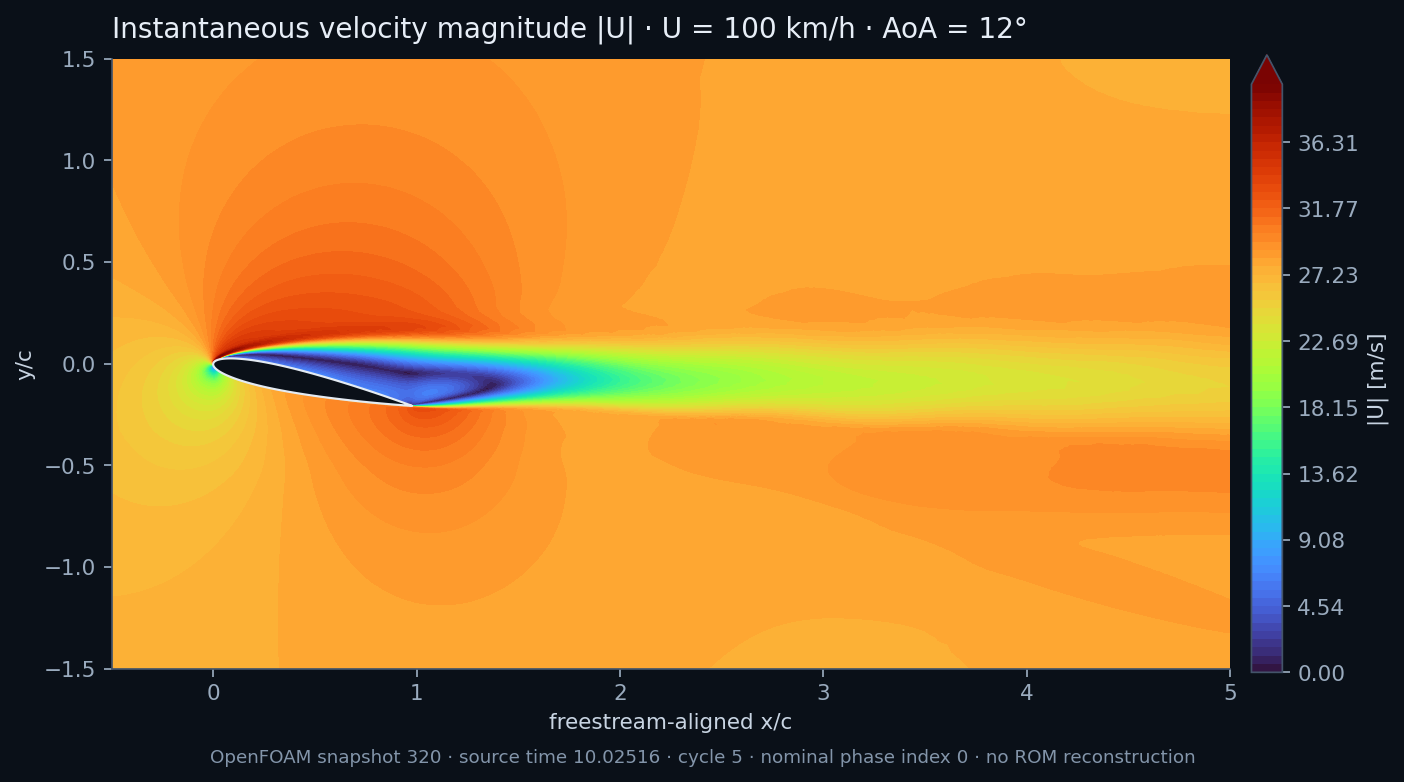
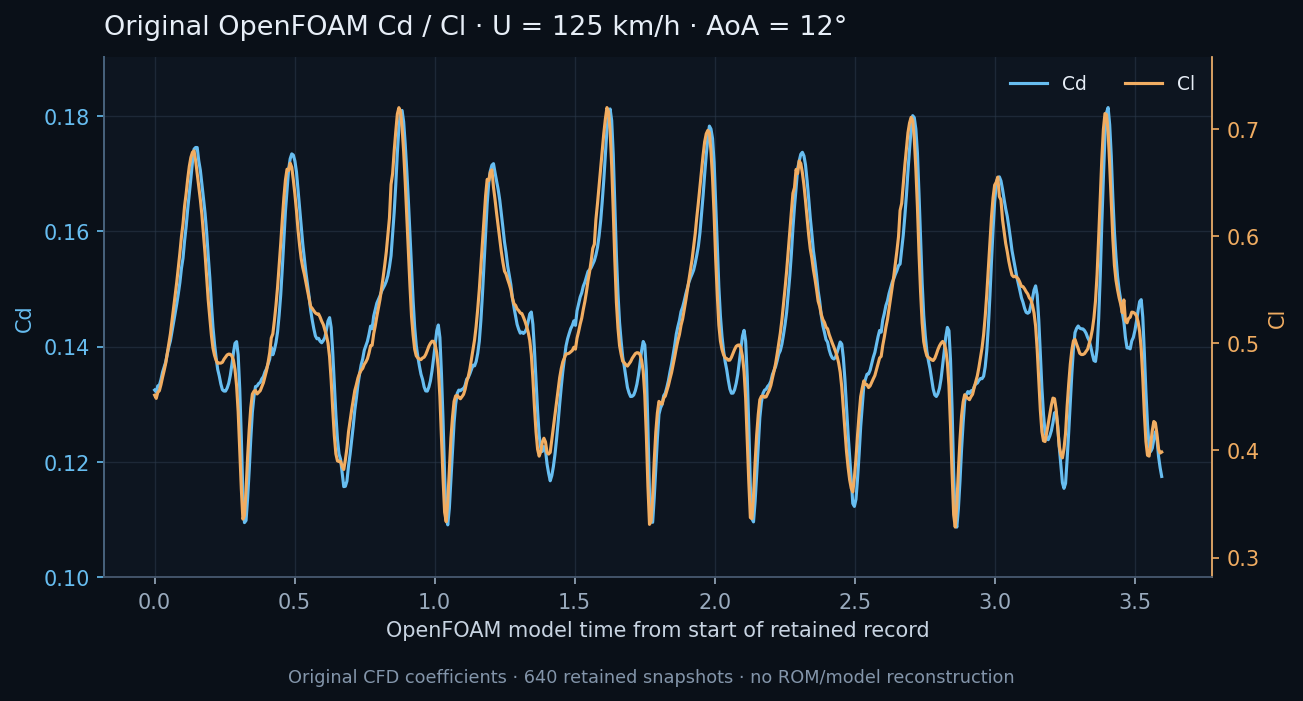
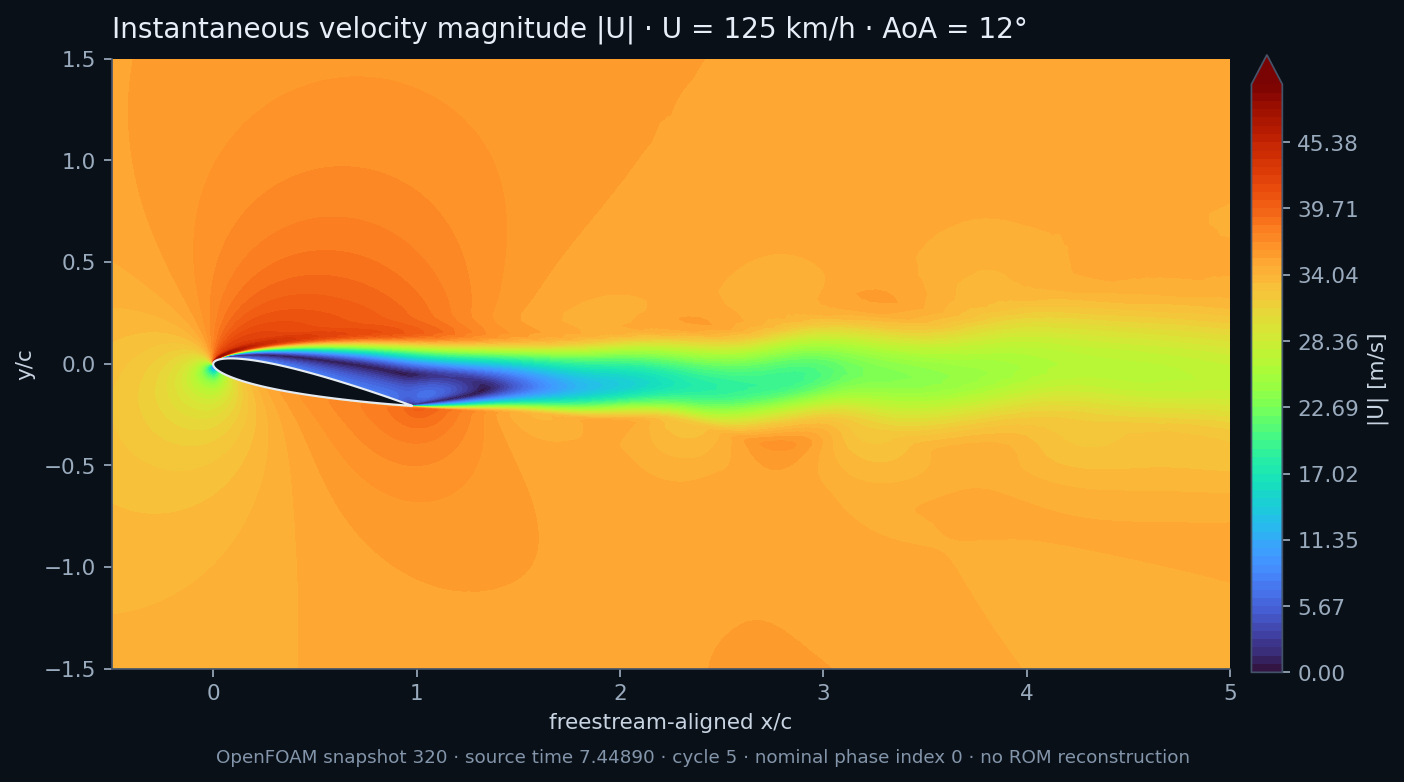
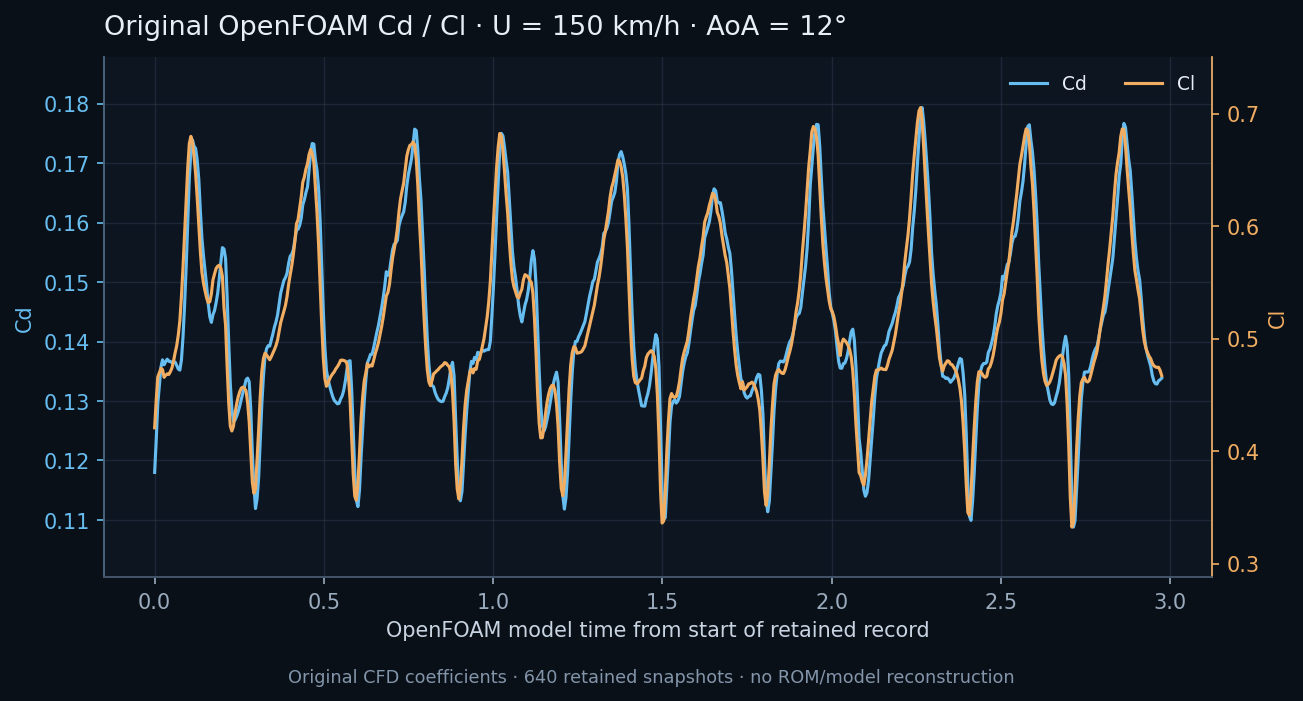
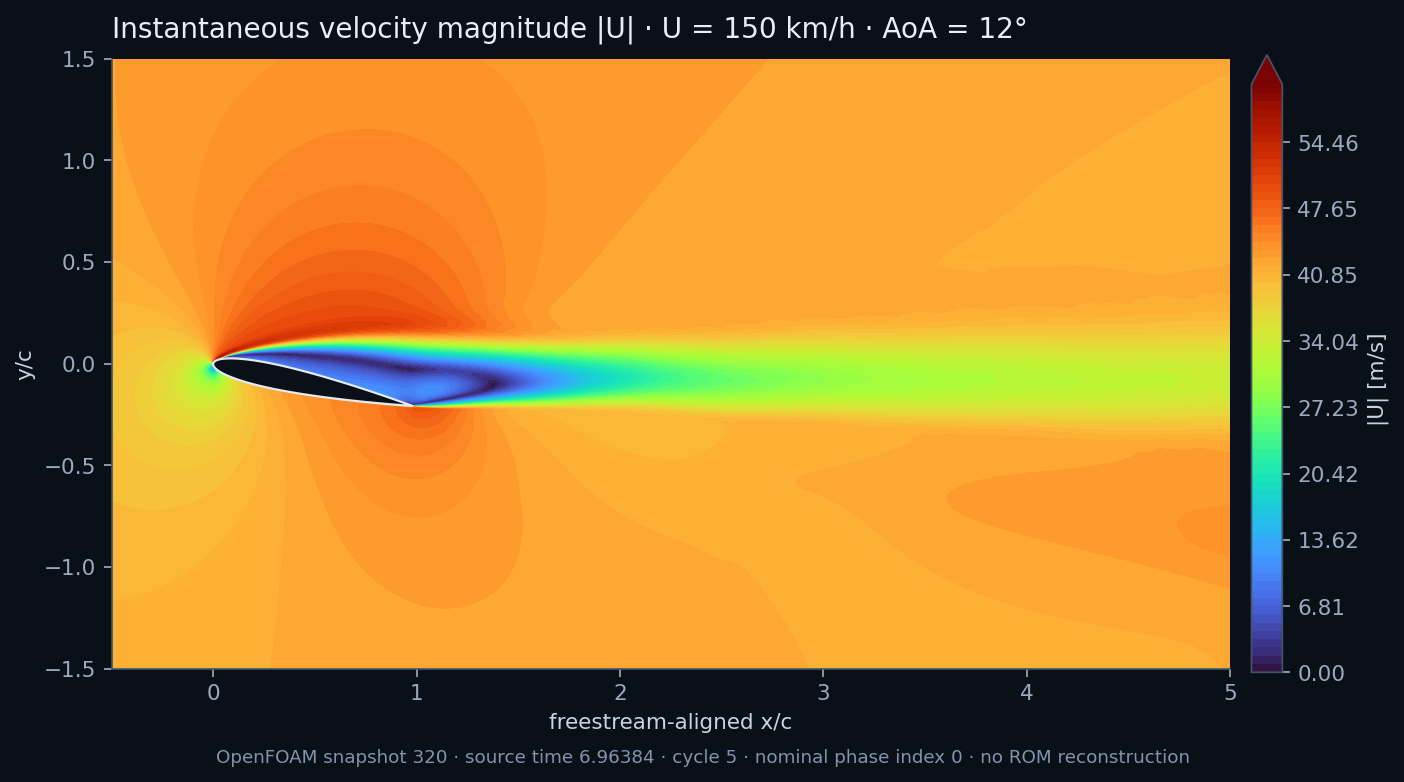
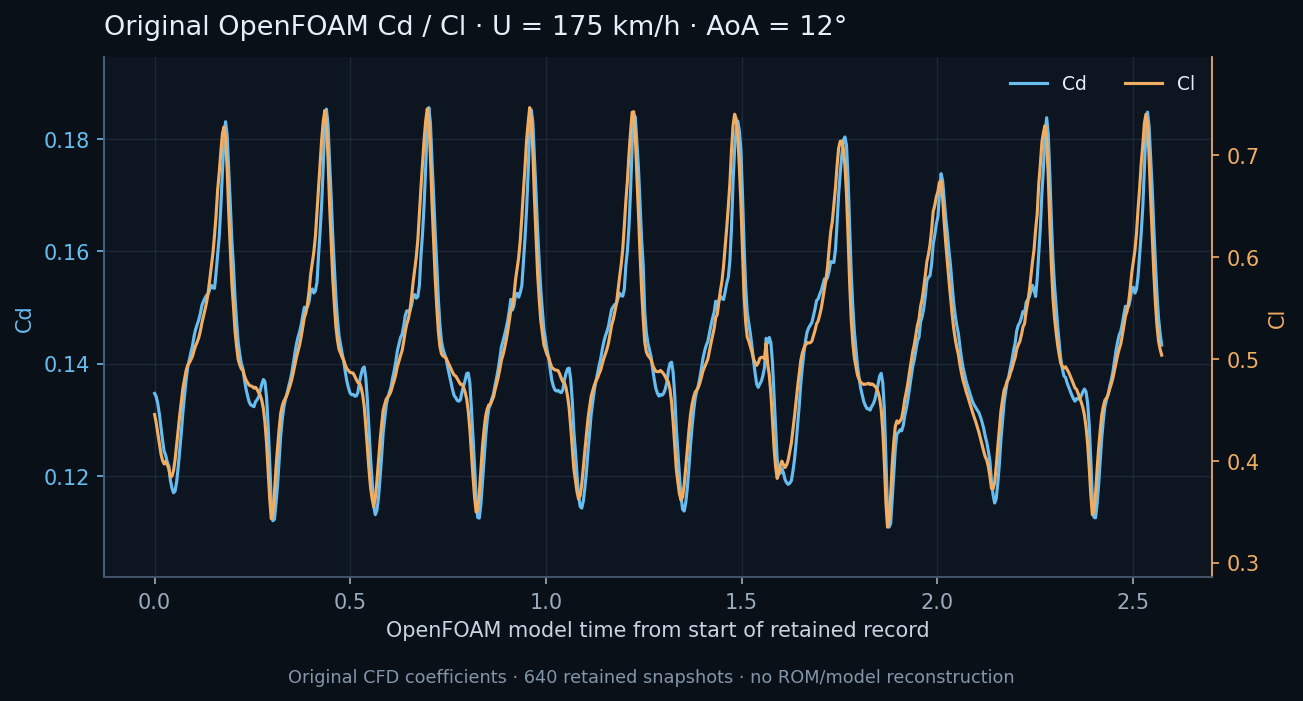
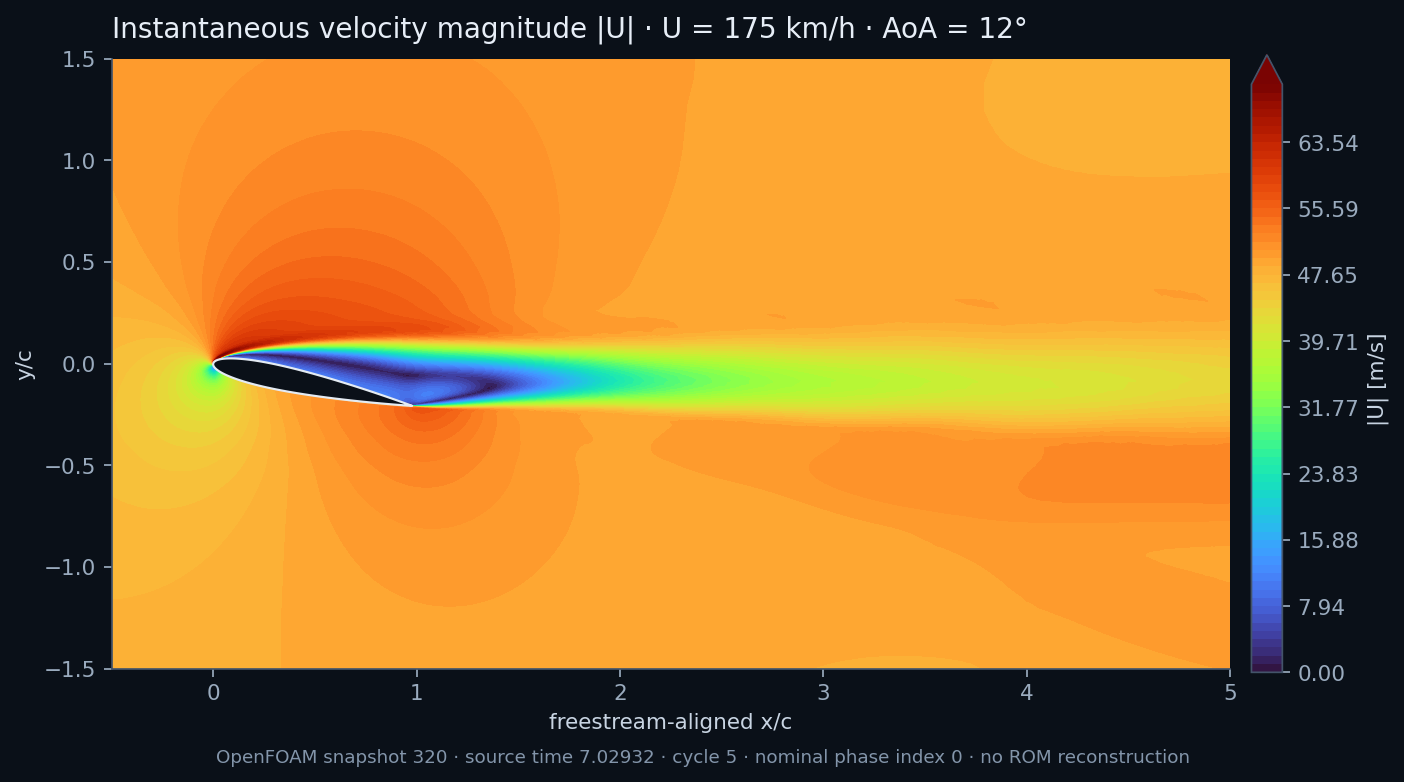
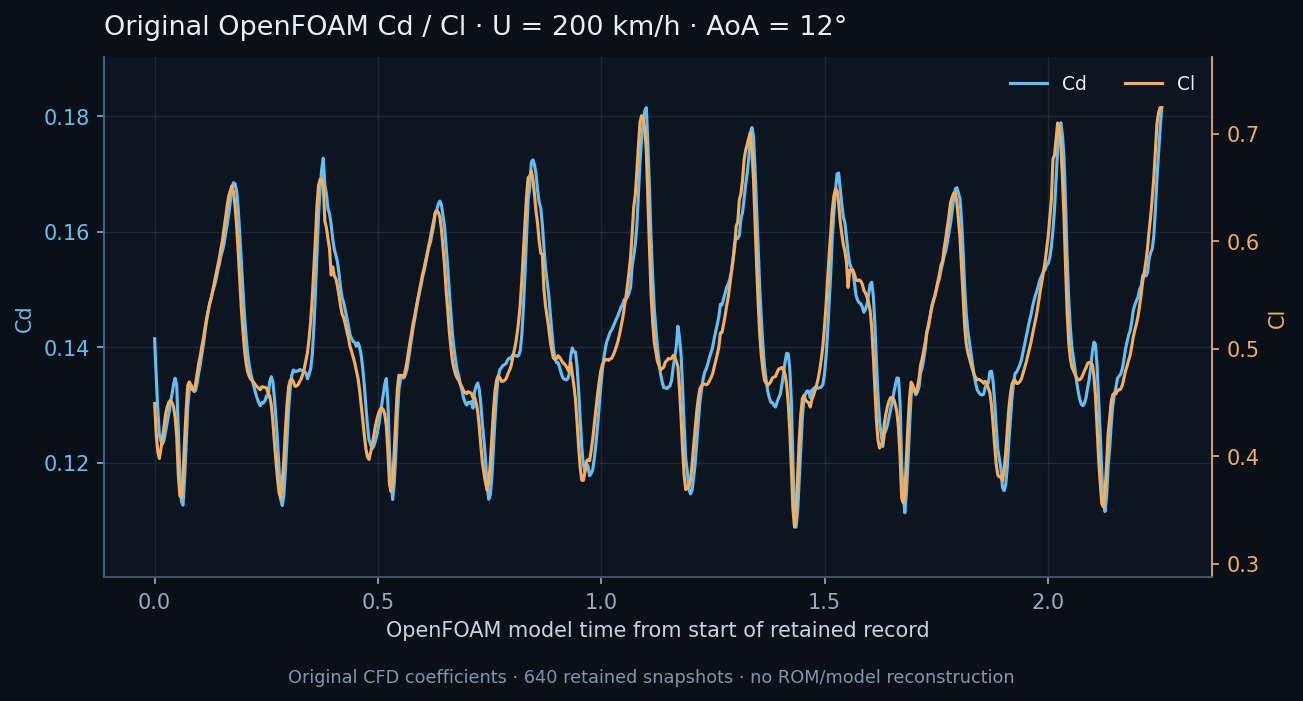
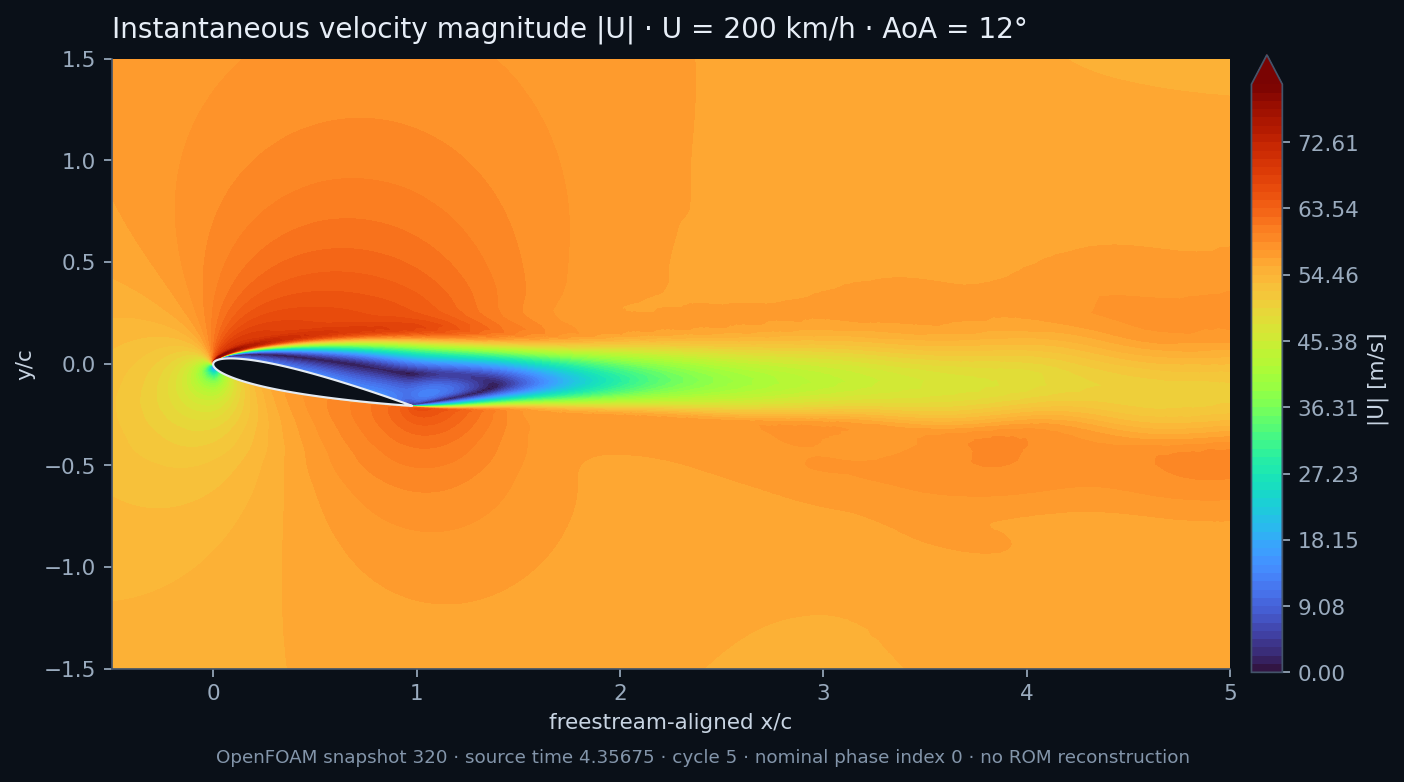
Each row keeps one OpenFOAM speed case together: the original Cd/Cl history on the left and one instantaneous velocity-magnitude field on the right. Force histories use the retained CFD values directly. The contour uses snapshot 320 (cycle 5, nominal phase index 0), also directly from the retained CFD field. No POD, phase averaging or ROM reconstruction is involved.
U050
50 km/h
AoA 12° · 640 retained CFD snapshots · contour: snapshot 320, source time 14.10128
U075
75 km/h
AoA 12° · 640 retained CFD snapshots · contour: snapshot 320, source time 10.36909
U100
100 km/h
AoA 12° · 640 retained CFD snapshots · contour: snapshot 320, source time 10.02516
U125
125 km/h
AoA 12° · 640 retained CFD snapshots · contour: snapshot 320, source time 7.44890
U150
150 km/h
AoA 12° · 640 retained CFD snapshots · contour: snapshot 320, source time 6.96384
U175
175 km/h
AoA 12° · 640 retained CFD snapshots · contour: snapshot 320, source time 7.02932
U200
200 km/h
AoA 12° · 640 retained CFD snapshots · contour: snapshot 320, source time 4.35675
DATA PIPELINE
OpenFOAM → canonical HDF5 → parallel model tests
01Transient OpenFOAMaccepted CFD solution archives
→
02Reconstruct orderingconsistent volume / wall geometry
→
03Canonical HDF5one file per speed
→
04Model testsRaw POD · Phase/Residual · SPOD · SINDy
U, p, k, ω, νt
The current ROM tests primarily use u, w, pressure and ω, with physical cell-volume weighting where appropriate.
p + wall shear
Surface quantities support pressure/shear reconstruction and derived Cd/Cl rather than fitting force histories as unrelated scalars.
Stored once per case
Cell centers, cell volumes, wall centers and wall-area vectors define the consistent reconstruction space.
CFD remains ground truth
The surrogate methods are evaluated against this source. The public website does not ship the raw CFD/HDF5 dataset.
NEXT DATA LAYERS