MODEL TEST · SPARSE IDENTIFICATION OF NONLINEAR DYNAMICS
SINDy
SINDy was tested as an autonomous evolution model for POD coefficients: can a small set of sparse equations generate the reduced dynamics without replaying phase histories?
MIXED · PARKEDStrong r=2 velocity oscillator; higher-rank and surface-state closure remain weak
MAIN SUCCESS
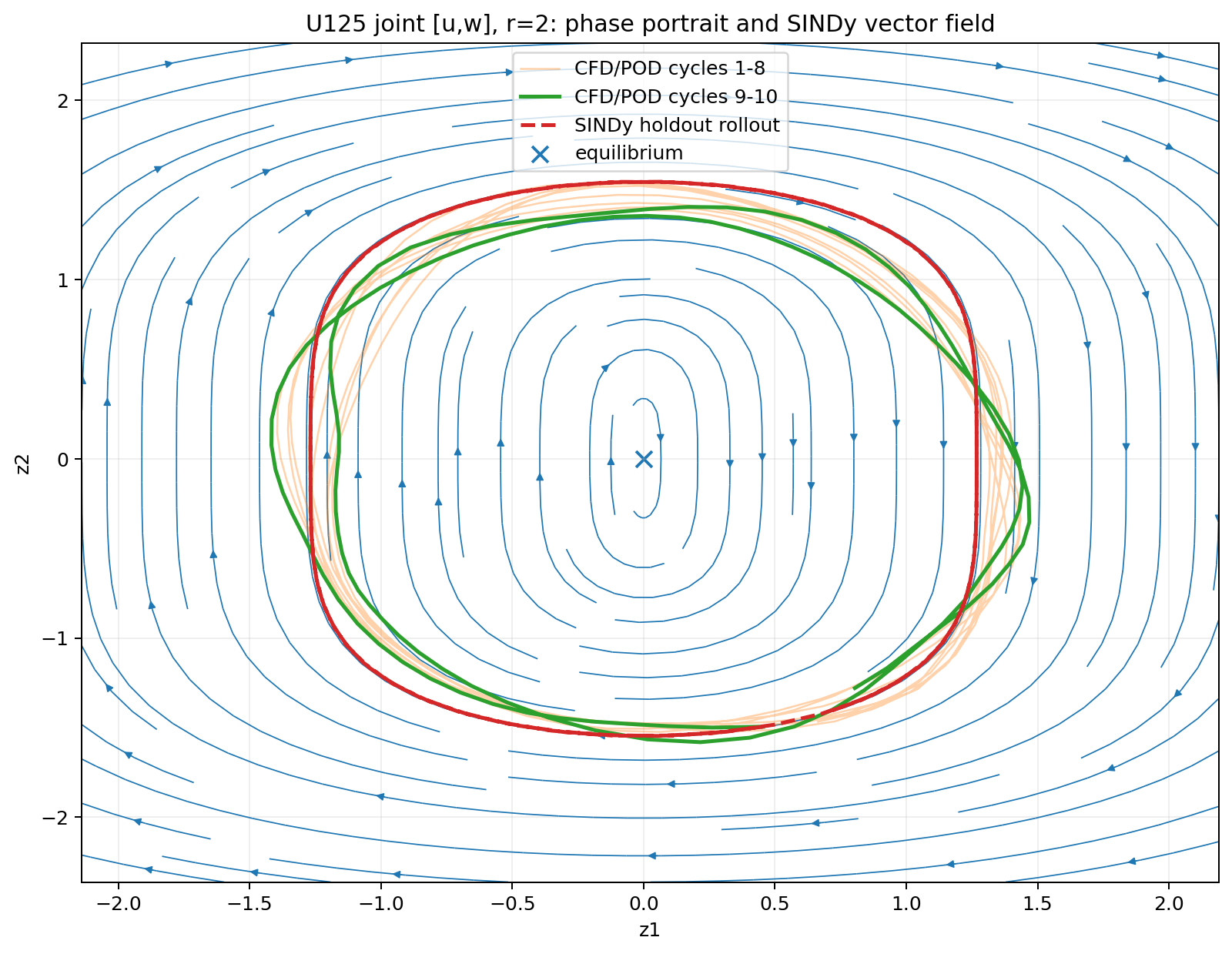
A very compact U125 joint velocity oscillator
dz₁/dt* = +0.0857794 z₂³
dz₂/dt* = −0.1528301 z₁
The identified model behaves as a conservative nonlinear oscillator. It is sparse, bounded and robust to derivative estimation, but it represents only the dominant two-state velocity dynamics.
WHERE IT BREAKS
More spatial states do not automatically produce a better autonomous model
Meaningful success
Sparse, stable and phase coherent. Long rollouts remain bounded and the discovered support is robust to derivative method.
Identification becomes difficult
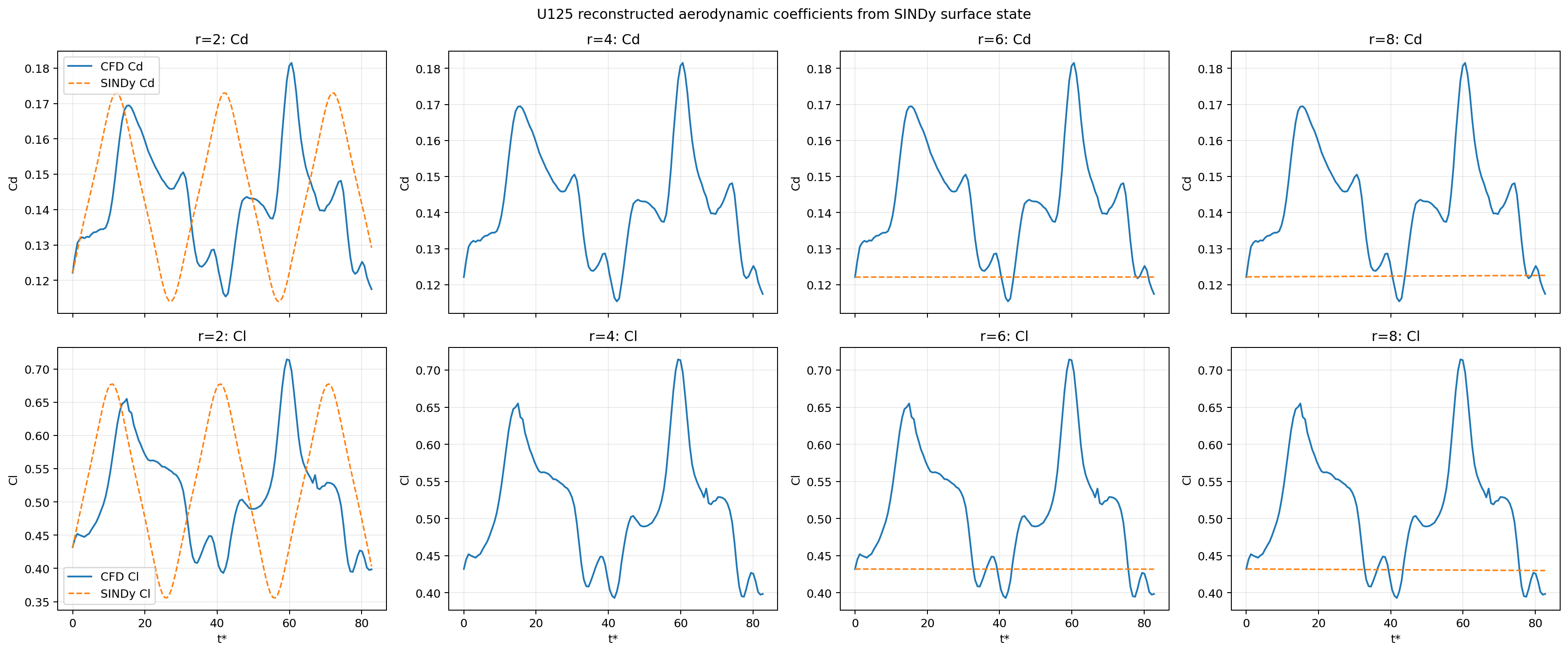
Higher POD rank improves spatial coverage, but models become dense, unstable or dynamically wrong. State dimension grows faster than reliable closure.
Autonomous closure fails
Surface POD reconstructs Cd/Cl very accurately with true coefficients, yet autonomous SINDy evolves those coefficients poorly. The bottleneck is dynamics/state closure, not POD compression.
SUMMARY
A useful discovery, not the current deployment path
What worked
The dominant joint velocity dynamics can collapse to an exceptionally sparse nonlinear oscillator. This is a genuine interpretable reduced-dynamics result.
What did notSimply increasing rank or changing polynomial order does not yield a reliable high-fidelity autonomous flow model. A trigonometric library improves local fit but loses sparsity and off-attractor robustness.
Current decisionThe SINDy track is parked. If revisited, the priority is state structure and closure—mode pairing, velocity-driven surface dynamics, memory/delay coordinates—not open-ended library hunting.